How Contactless ATM Cards Work Without a Battery
When you tap your bank card on a POS terminal or an ATM, it feels almost magical. There is no visible power source on the card, yet it powers up, talks to the machine, and completes a secure transaction in under a second.
The reason this works is simple but elegant: the card is passive. It does not have a battery. Instead, it harvests a tiny amount of energy from the electromagnetic field generated by the payment terminal.
What Actually Happens When You Tap
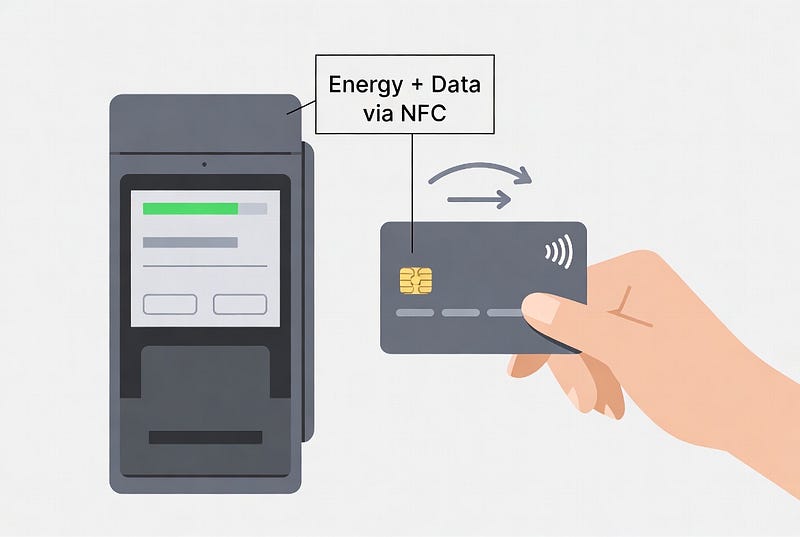
When you bring your contactless card close to a terminal, the two devices communicate using a technology called Near Field Communication (NFC), which typically operates at 13.56 MHz over a very short distance (a few centimeters).
- The terminal generates an alternating electromagnetic field around its reader.
- Your card enters this field and couples to it using a small coil antenna inside the plastic.
- This coupling allows the card to draw just enough energy to power its internal chip and exchange data securely.
You can think of it like a tiny wireless transformer: the reader is the primary coil, and your card is the secondary coil.
Inside the Plastic: Antenna and Chip
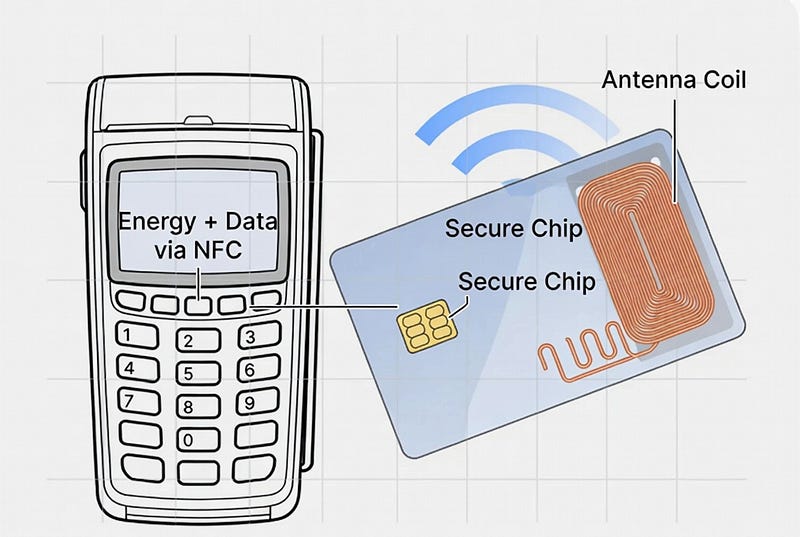
A modern contactless bank card is much more than printed plastic. If you could peel back its layers, you would find two critical electronic components:
- A loop antenna — usually a thin copper coil that runs around the perimeter of the card.
- A secure microchip (IC) — a tiny integrated circuit responsible for power management, communication, and cryptography.
When the card enters the terminal’s electromagnetic field:
- The changing magnetic field induces an AC (alternating current) voltage in the coil (Faraday’s law of induction).
- This induced voltage is small, but the system is engineered so that it is enough for the ultra‑low‑power chip.
- The coil is directly connected to the chip, which immediately starts converting and using this energy
From Field Energy to Usable Power
The chip inside the card cannot run directly from the raw AC signal induced in the antenna. It needs a stable DC (direct current) voltage, just like a microcontroller on a circuit board. To make this possible, the chip includes a miniature power supply stage.
Power Conversion Steps
- AC induction
The antenna coil picks up an AC voltage from the reader’s field. - Rectification
A rectifier circuit (often a diode bridge or an integrated active rectifier) converts the AC signal into a pulsating DC voltage. - Smoothing and storage
A capacitor inside the chip smooths the pulsating DC into a relatively stable voltage and stores a small amount of energy. - Regulation
A voltage regulator ensures the chip receives a safe, stable operating voltage. - Chip wake‑up
Once the voltage crosses a certain threshold, the chip powers on and begins executing its protocol.
Because the chip is designed to be extremely efficient and only runs for a fraction of a second per transaction, the harvested energy is sufficient to perform all required operations.

How the Card Talks Back: Load Modulation
Receiving power is only half of the story. The other half is communication. The card needs to send information back to the reader without generating its own strong radio signal, which would cost much more energy.
To solve this, contactless cards use a clever technique called load modulation.
The Idea Behind Load Modulation
- The terminal continuously generates its electromagnetic field.
- Inside the card, the chip can quickly switch additional load (like a small resistor or transistor circuit) on and off across the antenna.
- When this load is switched on, the card draws slightly more energy from the field; when switched off, it draws less.
- These tiny changes in load create very small variations in the field that the reader can sense.
- By toggling this load in a specific timing pattern, the card encodes bits (0s and 1s) that represent data.
In other words, instead of shouting with its own transmitter, the card “tugs” on the reader’s field in a controlled way, and the reader listens for those tugs.

The Protocol: From Tap to Approved
Under the hood, the card and reader follow standardized communication protocols defined by ISO/IEC and EMV specifications. While the electrical behavior is happening at the analog level, the data exchange is digital and structured.
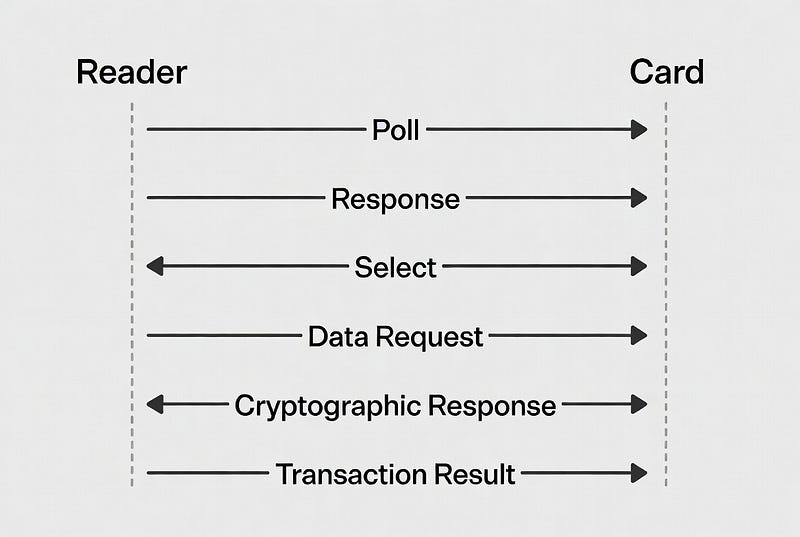
Typical Contactless Transaction Flow
- Polling
The reader periodically sends out a “Are there any cards nearby?” request. - Card detection and anti‑collision
When the card enters the field, it responds with a unique identifier. If several cards are present, the protocol resolves which one to talk to. - Selection and activation
The reader selects a specific card and switches to a higher‑level protocol (for example, EMV contactless for payments). - Mutual communication
The reader sends commands (for example, requesting application data or a cryptographic response). The card processes these using its secure chip and sends answers back via load modulation. - Cryptographic verification
The card generates dynamic cryptographic data for the transaction. The reader forwards this to the issuer or payment network for verification. - Result
The bank or issuer system approves or declines the transaction, and the terminal displays the result.
All of this typically happens in a few hundred milliseconds, which is why tapping feels instantaneous.
Security: Passive Hardware, Active Protection
Although the card is passive in terms of power, it is very active in terms of security.
Modern contactless payment cards typically include:
- A secure element: a hardened microcontroller designed to protect secret keys and resist tampering.
- Dynamic data generation: instead of broadcasting a static card number, the card generates transaction‑specific cryptograms or dynamic codes.
- Standardized security protocols: EMV and related standards define how authentication, integrity, and (in some cases) encryption are handled.
As a result:
- Simply listening to the NFC communication is not enough to clone a card.
- Replaying a previously captured transaction is generally useless, because the dynamic data becomes invalid after use.
- Physical access to the chip is difficult to exploit, as it is designed to resist invasive attacks.
Why a Battery-Free Design Is Ideal
Using energy harvesting instead of a battery gives contactless cards several practical advantages:
- Longevity
There is no battery to wear out. The limiting factors are physical wear, standard expiration dates, and changes in card technology or security standards. - Thin and flexible
The absence of a battery allows the card to remain thin, flat, and flexible enough for wallets and card slots. - Low cost and high reliability
Fewer components mean reduced manufacturing cost and fewer potential points of failure. - No charging or maintenance
The card works whenever it is near a compatible reader. There is nothing for the user to configure, charge, or maintain. - Short range as a security feature
The limited operating distance (typically a few centimeters) reduces the risk of unintended reads and makes it harder for attackers to interact with the card from afar.

The terminal is like a small “energy bubble.” When you bring your card into that bubble, the card briefly comes alive, proves its identity using secure math, sends back just enough information to complete the transaction, and then goes back to sleep as soon as you move it away.

Comments
Post a Comment